
Osteoarthritis impacts nearly 350 million people worldwide. If you’re one of them, you know knee pain can really put a damper on your day-to-day activities. To tackle this, your doctor might suggest knee surgery. Now, surgery can sound scary, but here’s the good news: MicroPort Orthopedics has decades of experience creating cutting-edge products designed to help people like you get back to living an active life. So, let’s kick knee pain to the curb and get back to dancing in the kitchen!
Knee pain can feel like your body’s unwelcome alarm clock, and there are several reasons for it. When the cartilage in your knee joint gets damaged or wears down (thanks to conditions like osteoarthritis), your knee bones start to rub together. This bone-on-bone action causes friction, pain, and even more damage. Osteoarthritis is the usual suspect behind knee replacements, but it’s not the only one causing trouble. There are other forms of arthritis, like Rheumatoid Arthritis and Traumatic Arthritis, as well as non-arthritic trauma, all of which can lead to knee pain and cramp your style. So if your knee’s been giving you grief, you’re definitely not alone, and there are ways to get back to enjoying life!


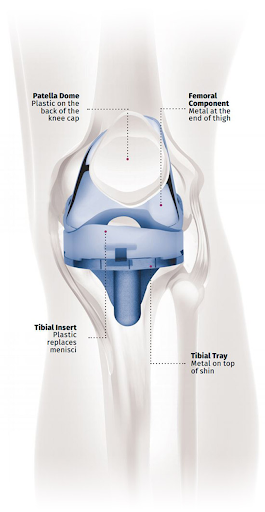
So, your knee has been giving you a hard time, and you’ve tried everything from icing it to hoping it magically fixes itself. When all else fails, your doctor might suggest the big guns: total knee replacement (or TKR, if we’re being fancy). It’s like a makeover for your knee, aiming to restore its function and kick pain to the curb.
During the surgery, the worn-out surfaces of your knee bones get swapped with smooth artificial ones made of metal and plastic. These new bits are designed to work like a charm, mimicking your natural knee movement and saying ‘sayonara’ to that bone-on-bone discomfort.
Precision is key here: special tools are used to shape your bones to fit the new knee implant just right. A metal tray is snugly placed on top of your tibia, with a plastic insert locked in to act as your new cartilage. On the femur side, a shiny metal component is attached to cap things off. And if your patella (knee cap) is also causing trouble, it might get a plastic dome makeover too!
It’s like giving your knee a new lease on life, so you can get back to doing the things you love, pain-free!
Good decisions start with the right information.
There’s a lot of talk about knee replacement surgery – some of it helpful, some of it… not so much.
Let’s clear up a few of the biggest myths so you can make your decision based on facts, not fear.
Myth 1: “I’m too young for a knee replacement.”
Fact: Knee replacement isn’t about age – it’s about quality of life. If pain, stiffness, and reduced mobility are holding you back, surgery might be the right option, whether you’re 45 or 75.
Myth 2: “Recovery takes forever.”
Fact: With modern techniques and implants like the Evolution® Medial-Pivot Knee, many patients are up and walking the same day as surgery – and back to most activities far sooner than they expect.
Myth 3: “I won’t be able to do the things I love anymore.”
Fact: The goal of knee replacement is to get you back to doing what you love – whether that’s gardening, cycling, playing with your grandkids, or long walks on the beach.
Myth 4: “All knee replacements feel the same.”
Fact: Not true. Different designs perform differently. The Evolution® Medial-Pivot Knee is designed to mimic the natural stability and movement of a healthy knee, giving many patients a more natural feel and better confidence.
Myth 5: “I should wait until the pain is unbearable.”
Fact: Waiting too long can make recovery harder. The earlier you address the problem, the better your chances for a smoother surgery and a quicker return to full function.
Don’t let outdated information keep you from a better life. The best way to know if a knee replacement is right for you is to talk to a specialist who can guide you through your options.
* required fields